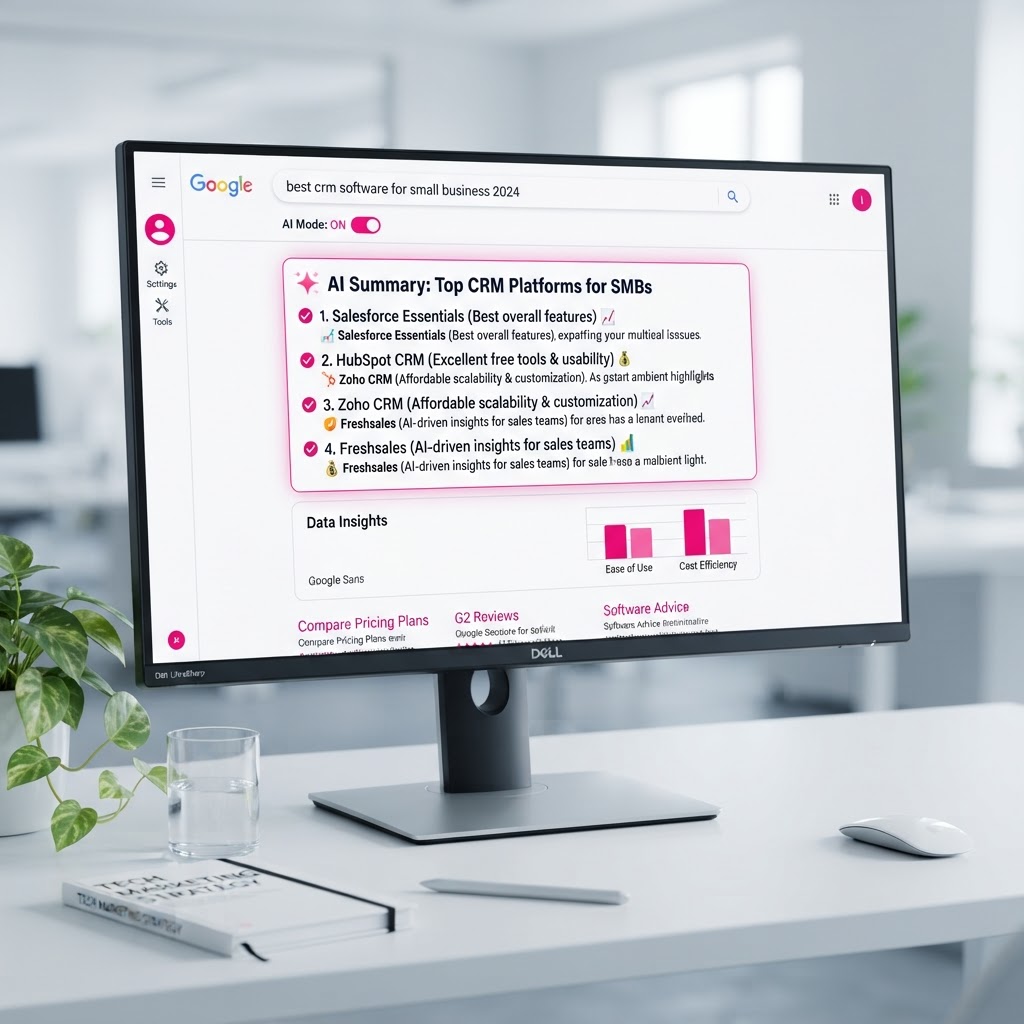
Google's AI Mode serves the answer directly. No blue links. No traffic. Just an answer your customer reads and moves on.
Unless you're the one being cited.
That's the new game. Get cited or get invisible.
For two decades, the goal of SEO was clear: rank on page one, get the click, earn the traffic. Google's AI Mode has quietly ended that entire model. The answer engine doesn't send your prospect to your site — it reads the answer to them and moves on. The click never happens. The traffic never arrives.
What Google's AI Mode Actually Does
When a user asks a question in Google's AI Mode, Google generates a synthesized answer pulling from multiple sources — and displays that answer front and center. The traditional list of ten blue links is pushed below the fold, or removed entirely.
The user reads the answer. They don't click. They move on.
This is the death of the click-through as we knew it. A #1 ranking in AI Mode is not a #1 ranking in the old Google. It's a sentence in a synthesized answer — and only the brands cited in that sentence matter.
Why Most Site Owners Won't See It Coming
Here's the brutal part: most site owners are going to notice the drop before they understand why.
Organic traffic will decline. Rankings reports will look fine. The keyword still "ranks." But the clicks don't come — because the user never reaches the results page. They got their answer from the AI layer above it.
By the time analytics show the decline, the brand has already been invisible for weeks.
What AEO and GEO Actually Decide
Answer Engine Optimization (AEO) and Generative Engine Optimization (GEO) are the disciplines that determine who gets cited — and who disappears — inside AI-generated answers.
The model doesn't pick the oldest domain. It doesn't pick the biggest ad budget. It picks the sources it trusts most for that specific question. And those sources tend to share three traits:
1. They're mentioned where AI already looks
AI models source their answers from Google's most-trusted, most-clicked sites — which are overwhelmingly user-generated content platforms: Reddit, LinkedIn, YouTube, TikTok, X, Instagram, Facebook. If your brand is being discussed on those platforms with the exact phrases buyers use in their questions, AI will surface those mentions.
2. They make clear, citable claims
AI extracts declarative sentences. "The best CRM for solos is [Brand] because..." gets cited. "A comprehensive guide to CRM options" does not. State your claim as a fact, with the reasoning attached, in language that matches how buyers actually ask the question.
3. They build corroboration across independent sources
One mention isn't enough. AI looks for consensus — the same claim repeated across multiple trusted sources. Reviews, comparisons, forum threads, podcast transcripts, social posts, and your own structured content all contribute. The more independent sources confirming your claim, the more confidently the model cites you.
The New Rules of Visibility
| Old Google | Google AI Mode |
|---|---|
| Rank in the blue links | Be the cited source in the answer |
| Optimize for clicks | Optimize for citations |
| Win the SERP | Win the synthesized answer |
| Traffic = the reward | Being recommended = the reward |
| Domain authority rules | Source trust + corroboration rules |
How to Become the Brand That Gets Cited
1. Get mentioned on the platforms AI already trusts
Reddit, LinkedIn, YouTube, TikTok, and X are the sources AI reads first. Get your brand recommended there — with the exact phrasing buyers use — and AI will pull those mentions into its answers.
2. Answer questions directly and declaratively
Don't write content that "covers a topic." Write content that answers a specific question in one clear sentence. AI cites the page that gives it the cleanest, most confident answer.
3. Build corroboration
Get the same claim repeated across multiple independent, trusted sources. One Reddit thread + one YouTube review + one LinkedIn post + one comparison article = consensus. Consensus = citation.
4. Backlink your social mentions
Backlinks are the durability layer. When your brand gets cited on a UGC platform, point links at that mention to tell Google (and the AI reading Google) that this content matters and should keep being cited.
5. Structure your own content for AI parsing
Clear headings. FAQ blocks. Concise, declarative answers. A page that answers "What is [your category]?" in one sentence beats a 2,000-word essay every time.
The Takeaway
Google's AI Mode doesn't send traffic. It serves answers. The brands that survive the shift won't be the ones with the best old-school SEO — they'll be the ones AI tools cite by name when a buyer asks a question.
Get cited, or get invisible. There is no middle ground anymore.