The Data That Reframes How You Think About Multi-Threading
Earlier this year, I released a course with 30 Minutes to President's Club on how to sell to the C-Suite. As part of it, we partnered with Gong to study 1 million B2B sales cycles.
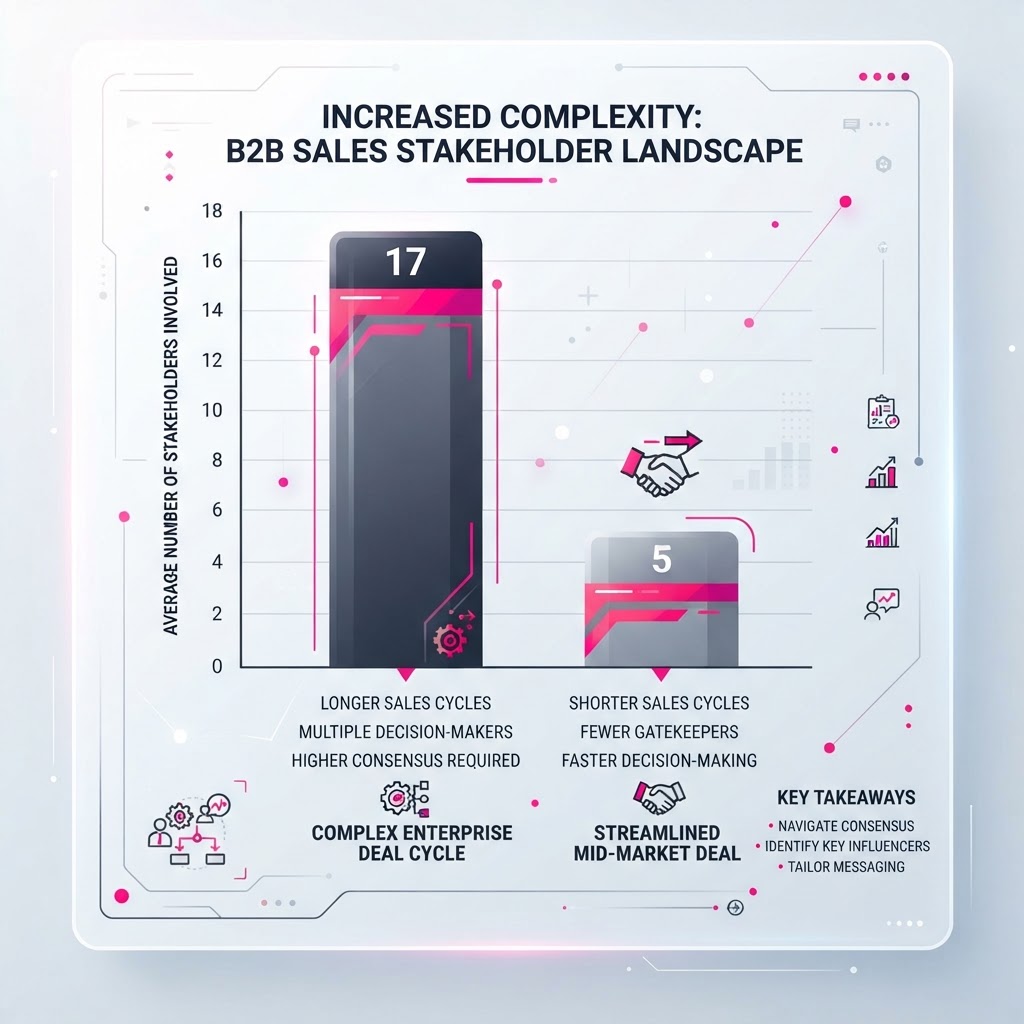
One of the most striking findings came from analyzing how many stakeholders got involved in closed won vs. closed lost deals — broken down by deal size.
The Numbers That Should Stop You in Your Tracks
At $250k+:
- Closed Lost deals → average of 5 stakeholders involved
- Closed Won deals → average of 17 stakeholders involved
Here's what makes this finding so important: those lost deals aren't single-threaded. The reps on those deals were working to engage multiple people. They just weren't engaging enough of them — and likely not the right ones.
This is why big deals often feel like you're dragging your prospect through mud. It's not a sign the deal is dying. It's the nature of enterprise buying.
Executive Involvement Is the Real Multiplier
Multi-threading matters. But multi-threading without executive access is incomplete.
Here are the win rate lift averages when you involve an executive (VP+) early in the deal:
| Segment | Win Rate Lift | |---|---| | SMB | +9% | | Commercial | +29% | | Mid-Market | +41% | | Enterprise | +43% | | Strategic | +49% |
The pattern is clear: the larger the deal, the more executive involvement compounds your odds of winning.
What This Means for Your Sales Motion
If your reps are multi-threading but still losing deals, the issue probably isn't quantity of contacts — it's quality and level of engagement.
Asking a champion to "introduce you to their boss" isn't executive selling. It's hoping for access. Real C-Suite engagement requires:
- A business case framed in their language (revenue, risk, efficiency — not features)
- Executive-to-executive outreach from your own leadership team
- Proactive identification of all economic buyers before the deal advances
The Metric Forward-Thinking Revenue Leaders Are Tracking
One emerging signal worth watching: % of deals with VP+ involvement.
A handful of companies are already tracking this as a leading indicator of deal health. If executive involvement correlates this strongly with win rate, it deserves a place in your pipeline reviews — not just your retrospectives.
The Takeaway
Multi-threading is necessary. Executive engagement is the multiplier.
If your sellers lack the skills to engage a C-Suite buyer effectively, adding more stakeholders to a deal won't be enough. Invest in teaching your team how to sell up — it's one of the highest-leverage skills in enterprise sales today.
Originally shared by Jen Allen-Knuth on LinkedIn. Data sourced from Gong's analysis of 1M+ B2B sales cycles, published in partnership with 30 Minutes to President's Club.